
From a French bequest to a papal inauguration
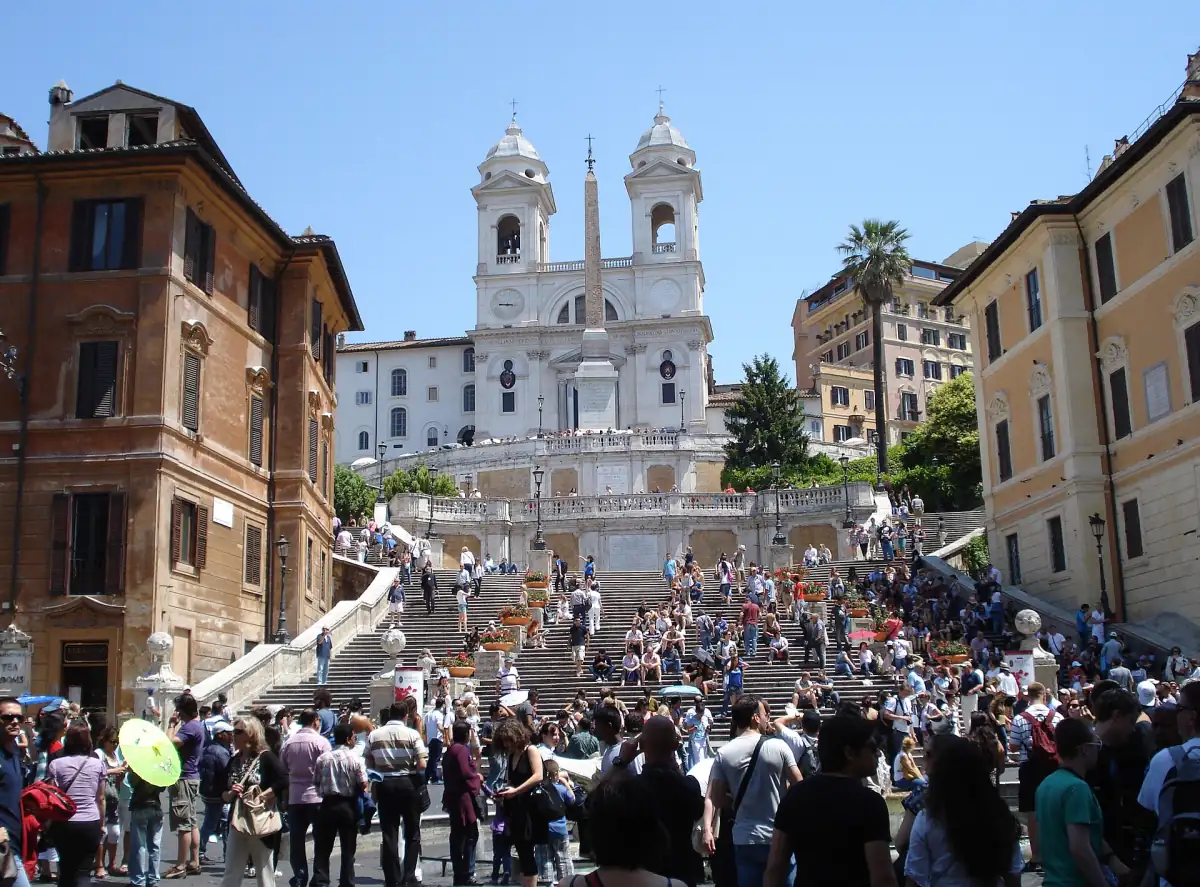
The Spanish Steps, in Italian the Scalinata di Trinità dei Monti, connect Piazza di Spagna with the church above. A stairway project is documented as early as 1559, but the steps as you see them today were built in the early eighteenth century. The architect was Francesco De Sanctis, and the steps were inaugurated in 1725, in the Jubilee year, by Pope Benedict XIII.
The steps are often credited to Bernini. That is not correct. The Barcaccia fountain at the bottom has a link to the Bernini family, but the stairway is De Sanctis's work. The name comes from the square, and the square takes it from the Spanish embassy.
Timeline of the Spanish Steps
The dates that matter, from the first plan to the latest restoration.
| When | What happened |
|---|---|
| 1559 | A stairway project to link the square with the church is already documented. |
| From 1660 | The bequest of the Frenchman Étienne Gueffier (Stefano in Italian) makes further designs possible. A dispute between the Papal States and the French crown delays the work. |
| 1723 to 1726 | Construction by Francesco De Sanctis. One city description of the upper square gives 1723 to 1725. |
| 1725 | Inauguration by Benedict XIII in the Jubilee year. |
| 22 September 2016 | The completion of a restoration is presented. Bulgari donated €1.5 million, and the steps reopened to the public the next day. |
The inauguration in 1725 is the date to use if you want one year. Building years vary by a year or so between descriptions, so a range is safer than a single date.
Spanish Steps tours and walks
Guided walks that put the steps in context, with live prices and availability.
Questions the history answers
Names, money and numbers.
Why are they called Spanish?
Piazza di Spagna is named after the Spanish embassy to the Holy See, which stands on the square at number 57. The name does not mean that Spain paid for the steps. The bequest of the Frenchman Gueffier made the designs possible, and the dispute between the Papal States and the French crown shaped the long wait.
Piazza di Spagna →Who designed them?
Francesco De Sanctis. The design joins the lower square to the upper square with flights that split and rejoin, balustrades and terraces, all in travertine.
Trinità dei Monti →How many steps are there?
The stairway is described as eleven flights of twelve steps. The total visitors quote most often is 135, and the count changes with how landings and edges are treated. Use 135 as a common figure, not as a measured one.
What was the 2016 restoration?
The work was presented on 22 September 2016, and the steps reopened the following day. Bulgari donated €1.5 million. It is a historical event and says nothing about today's opening times.
And the fountain at the bottom?
The Barcaccia is older than the steps and has its own story. Its latest restoration ended on 16 April 2025.
Barcaccia fountain →Is there a spring tradition?
In 2026 the azalea display ran from 16 April to 17 May, with more than 200 plants, and it extended along Via dei Condotti. The dates depend on the weather and change each year.
Best time to visit →The steps today
What is on the steps, and what is not allowed.
The steps are free to walk. Sitting and lying on them have been banned since 2019, so the steps work best as a place to walk up for the view. If you want the wider city story, Rome in one day has a page on the steps within a wider plan for the city, and the rules page explains what is allowed.
Spanish Steps history: frequently asked questions
When were the Spanish Steps built?
Building is dated 1723 to 1726, and one description of the upper square gives 1723 to 1725. The inauguration took place in 1725.
Who built the Spanish Steps?
The architect was Francesco De Sanctis. The steps are not a work of Bernini, although the Barcaccia fountain nearby has a link to the Bernini family.
Why are they called the Spanish Steps if the French paid?
The square is named after the Spanish embassy to the Holy See. The bequest of the Frenchman Étienne Gueffier made further designs possible from 1660, so the name points to the square, not to the funding.
Were there plans before the eighteenth century?
Yes. A stairway project is documented for 1559, and the bequest of 1660 led to further designs. A dispute between the Papal States and the French crown delayed the work until the 1720s.
Have the steps been restored?
Yes. A restoration was completed in September 2016, funded with €1.5 million from Bulgari. The steps reopened to the public the day after the presentation.